Call Flow Design Guide 2025: Best Practices, Templates & Real Examples
Quick Impact: This guide shows you how to reduce call abandonment by 47%, improve first-call resolution to 85%+, and save $2.70 per call using proven strategies from Amazon, Apple, and Fortune 500 companies.
What You'll Learn:
- ✓ Design call flows that reduce abandonment rates by up to 47%
- ✓ Implement AI-powered routing that saves $2.70+ per call
- ✓ Create IVR menus that achieve 85%+ first-call resolution
- ✓ Access free templates and real-world examples
- ✓ Measure ROI with industry-specific KPIs
- 27% of calls are lost to abandonment in average contact centers
- Every 1% improvement in FCR reduces operational costs by 1%
- AI-powered routing can close 30% more deals than manual assignment
- Conversational AI could reduce labor costs by $80 billion by 2026
- Modern call flows require deep CRM integration for true personalization
Beyond "Press One for Sales" - The Modern Call Flow as a Strategic Asset

The stark contrast: From frustrating traditional IVR to seamless AI-powered experiences
Imagine two scenarios. In the first, a customer calls your support line, is greeted by a robotic voice, and forced to navigate a labyrinth of nine irrelevant options. After incorrectly guessing a path, they are placed on hold for ten minutes, only to be connected to an agent who asks for the same account number they just entered. The customer, already frustrated, hangs up—a lost sale, a damaged relationship.
In the second scenario, a customer calls and is greeted by name by a natural-sounding voice assistant. "Welcome back, Sarah," it says. "Are you calling about your recent order for the X-1 Pro camera?" The system, powered by artificial intelligence and integrated with the company's CRM platform, has already anticipated the reason for the call. It offers a direct path to track the shipment, check the return policy, or speak with a camera specialist. The entire interaction is seamless, personalized, and efficient.
This stark contrast illustrates a fundamental shift in the role of the call flow. It is no longer a simple, back-end operational tool for routing phone calls. In the modern experience economy, the call flow has become a primary driver of customer experience (CX), a critical component of operational efficiency, and a direct lever for revenue generation. A well-architected call flow builds trust, projects a professional and organized brand image, and demonstrates respect for the customer's time. Conversely, a poorly designed one actively erodes brand equity, creates customer frustration, and incurs significant, often hidden, financial costs.
Part I: The Strategic Imperative - Why Call Flows Demand Executive Attention
To justify investment in modernizing a core business process, leaders must first understand the profound financial consequences of inaction. The traditional, friction-filled call flow is not merely an inconvenience; it is a direct drain on revenue and a significant driver of operational inefficiency.
Section 1.1: The High Cost of Friction - Analyzing the Business Impact
The Customer Impatience Threshold
The modern customer operates on a timeline measured in seconds, not minutes. An overwhelming 90% of customers consider an "instant" response to an inquiry to be crucial or very important. This expectation for immediacy is particularly acute in voice channels, where the #1 most frustrating aspect of a poor service experience is the hold time when waiting for an agent.
- 0-5 minutes wait:95% satisfaction
- 6-10 minutes wait:85% satisfaction
- 11-15 minutes wait:70% satisfaction
- 20+ minutes wait:55% satisfaction
The Anatomy of Abandonment
When customer patience runs out, the result is call abandonment—a caller hanging up before speaking to an agent. The call abandonment rate is one of the most critical indicators of a contact center's health. While industry benchmarks vary, an acceptable abandonment rate typically falls between 5% and 8%. Rates creeping towards 10% are considered high, and anything above this level should be treated as a red flag signaling systemic failures.
| Industry | Avg Abandonment Rate | "Good" Rate | Avg Speed of Answer | FCR Benchmark |
|---|---|---|---|---|
| Financial Services | 5-7% | <3% | ~28 seconds | 75-85% |
| Retail & E-Commerce | 4-7% | <3% | ~28 seconds | 70-80% |
| Healthcare | 7-9% | <5% | ~28 seconds | 70-80% |
| Telecommunications | 8-10% | <6% | ~28 seconds | 65-75% |
| Technical Support | 10-15% | <8% | 2-5 minutes | 65-75% |
Translating Metrics into Revenue
The data-driven reality: How poor metrics directly impact revenue and customer loyalty
High abandonment rates are not just a CX problem; they are a direct and quantifiable financial problem. The average contact center loses an astonishing 27% of its inbound calls to abandonment. More critically, over half of those customers will not attempt to call back, and 32% will never return to the business at all.
- BPO & Telemarketing:$1,500
- Healthcare:$4,000
- Travel & Hospitality:$4,800
- Fintech & Trading:$7,000
The FCR Multiplier Effect
The inverse of a frustrating, multi-call ordeal is First Call Resolution (FCR), a metric that measures the percentage of customer issues resolved in a single interaction. A "good" FCR rate is considered to be between 70% and 79%, with best-in-class centers achieving 74% or higher.
Research has shown that for every 1% improvement in FCR rate, a contact center's operational costs are reduced by 1%.
This is because resolving an issue on the first try eliminates the costs associated with repeat calls, follow-up work, and escalations. A high FCR not only delights customers but also creates a more efficient and cost-effective operation.
Section 1.2: The ROI of Intelligence - Cost-Benefit Analysis of Modern vs. Traditional Systems
Defining the Systems
- •Rigid touch-tone (DTMF) IVR menus
- •Static routing rules (round-robin)
- •Limited integration capabilities
- •Business hours only
- •Conversational AI with natural language
- •Dynamic, predictive routing
- •Deep CRM integration
- •24/7 availability
Cost Analysis

The financial equation: Modern systems deliver superior ROI despite higher initial investment
A surface-level comparison might suggest that traditional systems are cheaper due to lower initial software licensing costs. However, this view ignores the massive, ongoing operational costs they generate. The true cost of a traditional system lies in the high overhead required to support its inefficiencies: larger agent teams are needed to handle poorly routed and escalated calls, significant revenue is lost from high abandonment rates, and further costs are incurred from customer churn due to poor experiences.
Benefit Analysis and ROI
- • Reduction in Average Handle Time of up to 4 minutes per call
- • 5-7% reduction in unnecessary call transfers
- • Higher agent productivity with smaller, specialized teams
- • 30% more deals closed with AI-enhanced routing
- • 15% higher close rate on priority leads
- • 2x increase in overall close rate from contact center
- • 60% drop in customer wait times
- • 25% increase in customer satisfaction scores
- • 94% more likely to repurchase after low-effort resolution
- • 88% more likely to increase spending
Part II: The Architectural Blueprint - How to Design Effective Call Flows
Understanding the strategic importance of call flows is the first step. The second is mastering the principles of their design and architecture. An effective call flow is a carefully constructed blend of clear logic, intuitive user experience, and robust technology.
Section 2.1: Core Concepts and Terminology
- Call Flow
- The complete, step-by-step path a caller follows when contacting an organization, from initial greeting to resolution.
- IVR (Interactive Voice Response)
- The technology that enables automated call flows through pre-recorded prompts and menu options.
- DTMF (Dual-Tone Multi-Frequency)
- Touch-tone signals generated when pressing phone keys (e.g., "Press 1 for sales").
- ASR (Automatic Speech Recognition)
- Technology that converts spoken words into machine-readable text.
- NLP (Natural Language Processing)
- AI that understands the intent and meaning behind spoken words, not just transcription.
- CTI (Computer-Telephony Integration)
- Technology enabling seamless integration between phone systems and computer systems.
Section 2.2: Call Flow Design Patterns and Anti-Patterns
Common Design Patterns
Simple, sequential path for single-purpose tasks like bill payment or status checks. Best for predictable outcomes.
Conditional routing based on time of day, holidays. Routes to live agents during business hours, voicemail after hours.
Maximizes containment by offering robust self-service options upfront. Over 60% of US consumers prefer this for simple tasks.
Uses CTI and CRM integration to dynamically alter menus based on customer context and history.
The Anti-Patterns: Common and Costly Design Mistakes
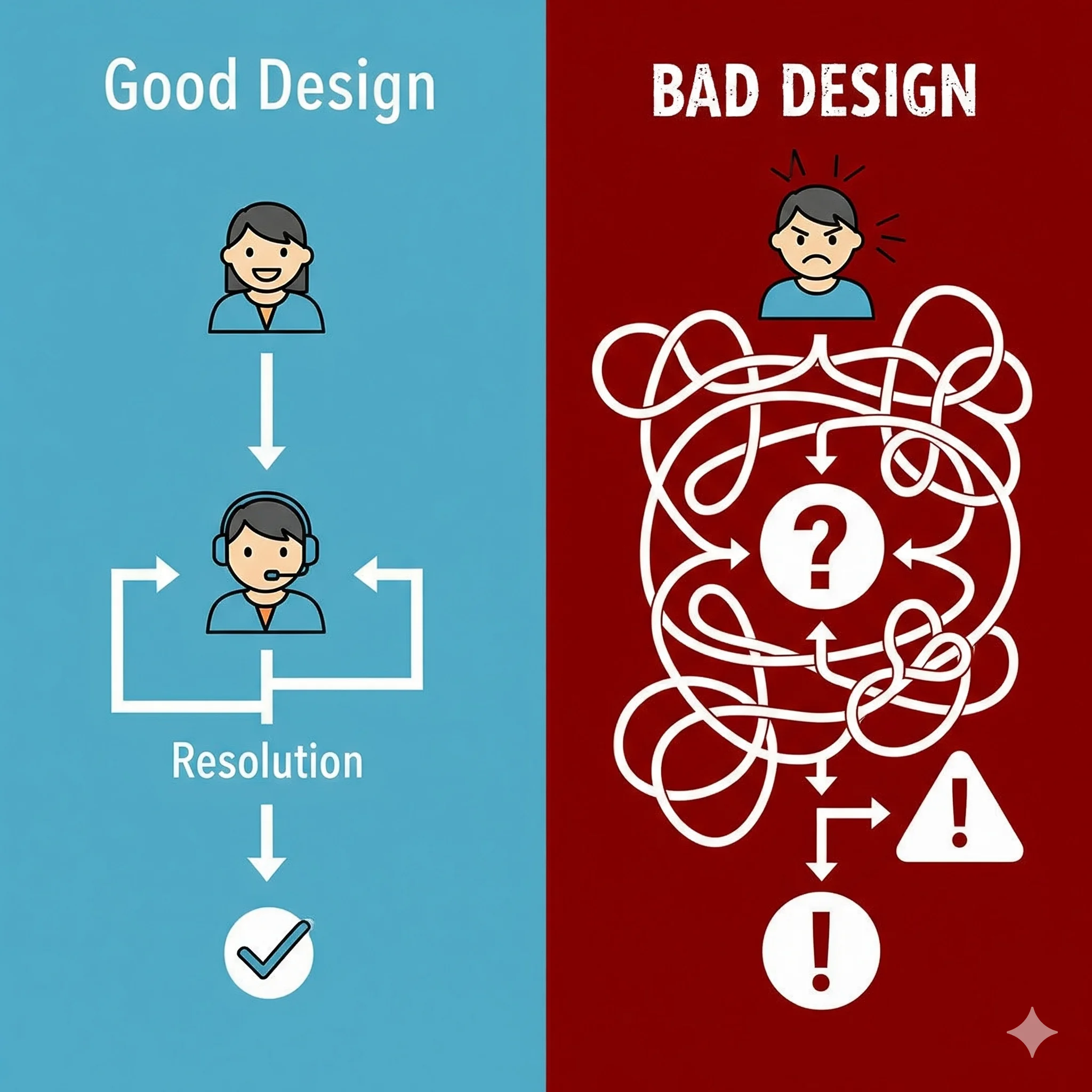
Clear paths to resolution vs. tangled mazes: The importance of logical flow design
Section 2.3: The Human Element - Voice UI/UX and Reducing Customer Effort
The major trend for 2025 and beyond is the definitive shift away from rigid, DTMF-based menus toward natural, conversational interactions. Powered by advancements in NLP and AI, modern Voice User Interfaces are designed to understand and respond to human language fluidly.
Design principle: Create a flow, not a form.
Practical Strategies for Reducing Effort

Modern voice interactions: Customers expect natural, personalized, and quick experiences across all platforms
Instead of forcing customers to wait on hold, offer callbacks when agents become available without losing queue position.
Analyze call data to identify common reasons and place these options first in the IVR menu.
All information collected by IVR must automatically pass to agents, eliminating repetition.
Use CRM data to anticipate needs and offer relevant options based on recent events.
Part III: The Technology Engine - Powering the Modern Contact Center
The evolution from simple call distribution to intelligent, predictive matching represents a paradigm shift in how contact centers operate. This section explores the specific technologies that form the engine of the modern call flow.
Section 3.1: The Evolution of Routing - From Basic Queues to Predictive Matching
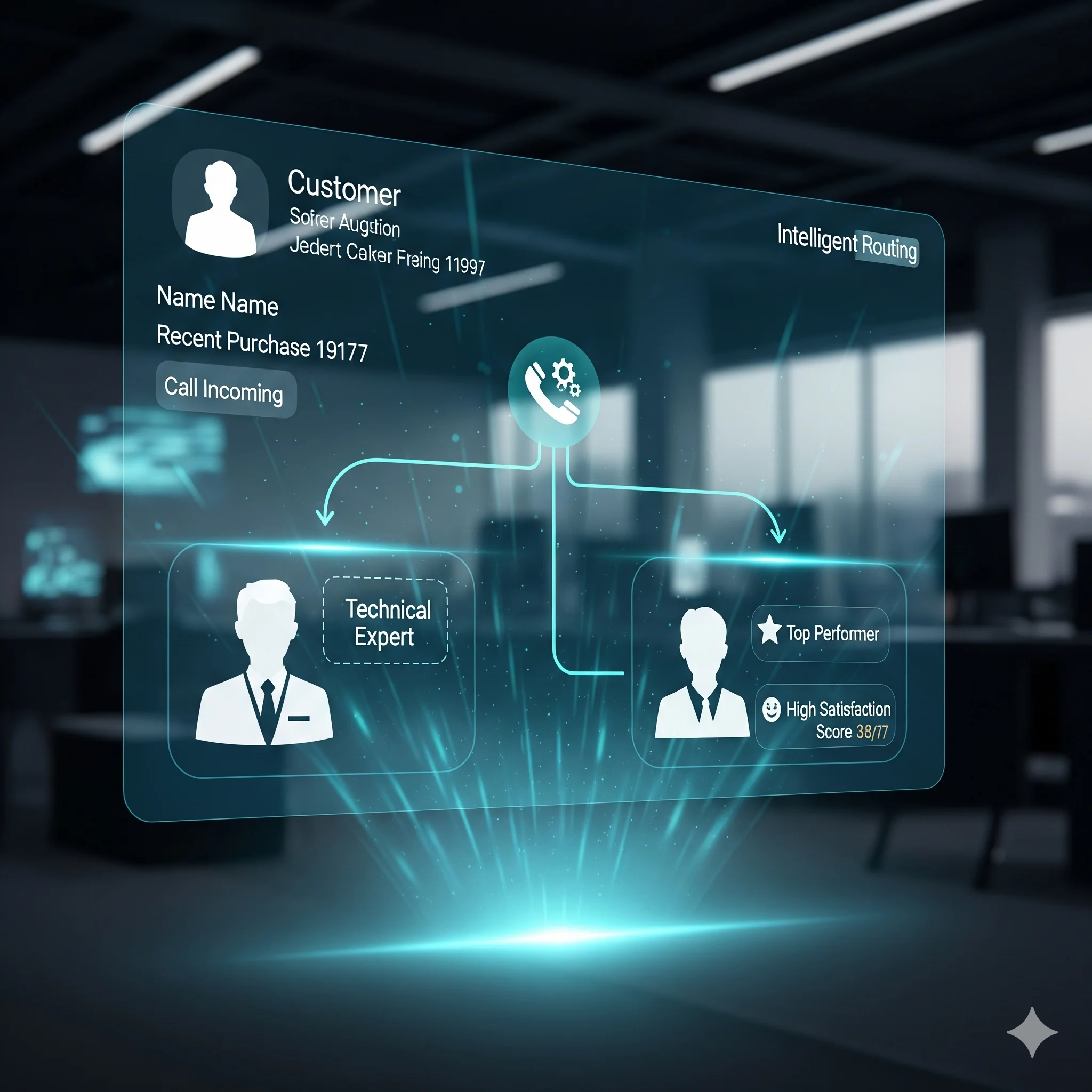
Next-generation routing: AI analyzes customer profiles to match with the perfect agent
| Feature | Standard Routing | Skills-Based (SBR) | Predictive Routing |
|---|---|---|---|
| Core Mechanism | Routes to next available agent | Matches requirements to agent skills | AI scores agents for optimal match |
| Primary Goal | Minimize wait time | Improve FCR | Optimize specific KPIs |
| Key Data | Agent availability | Agent skills, IVR selections | Performance history, CRM, sentiment |
| Adaptability | Static rules | Manual skill updates | Continuous AI learning |
| Impact | Low to moderate | High FCR impact | Highest FCR and CSAT |
The Machine Learning Engine
Predictive routing is powered by machine learning models that analyze vast arrays of data points in real-time. These models continuously retrain with the latest interaction data, adapting to changing business conditions and agent performance.
Agent Data
- • Historical performance
- • Average handle time
- • FCR rates by issue type
- • Customer satisfaction scores
- • Sales conversion rates
Customer Data
- • Purchase history
- • Previous interactions
- • Sentiment from prior calls
- • Customer value/VIP status
- • Preferences and patterns
Interaction Data
- • Real-time intent analysis
- • Issue complexity scoring
- • Time of day patterns
- • Current call volumes
- • Channel history
Section 3.2: The AI Revolution in Call Management - 2024-2025 Innovations
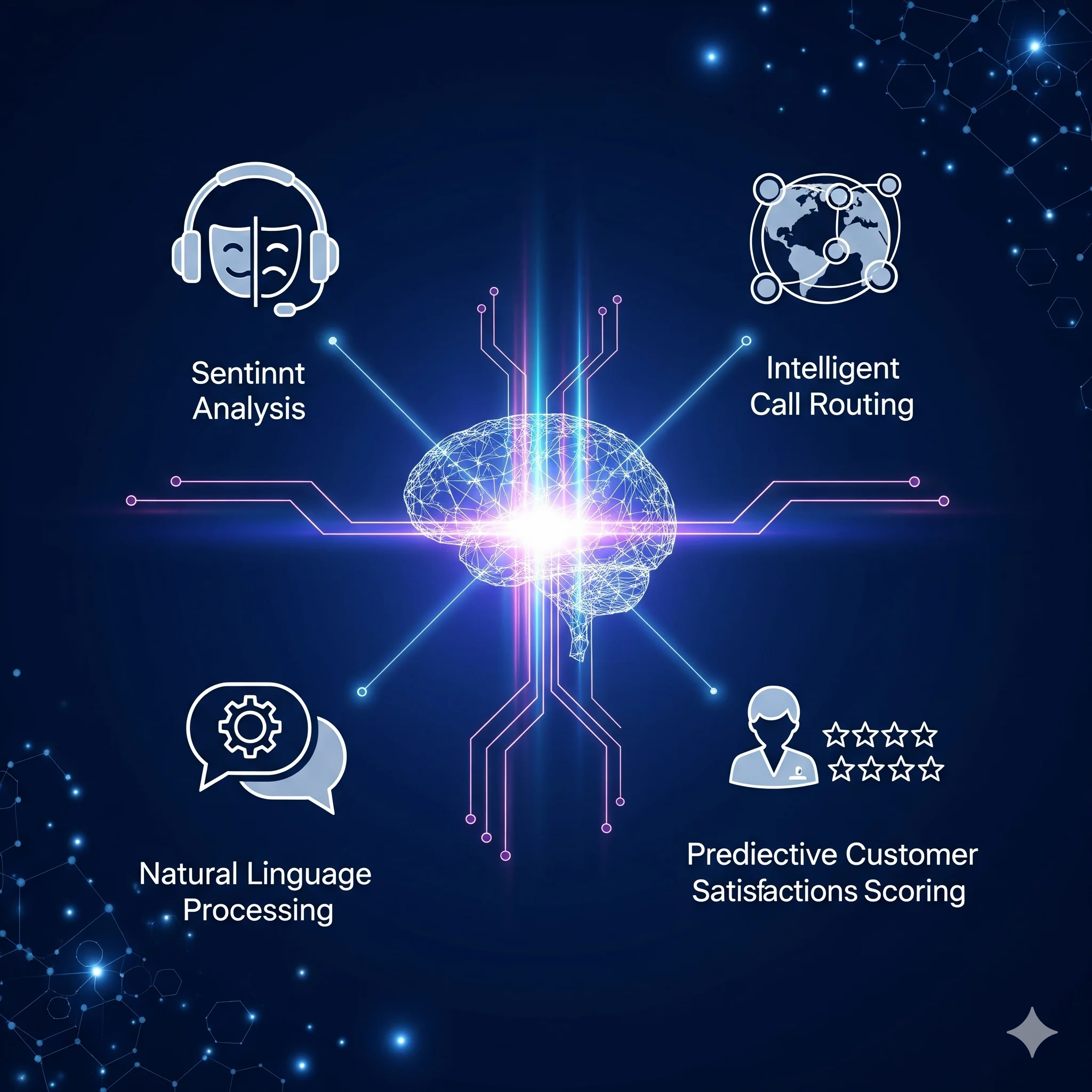
The AI brain: Machine learning algorithms power predictive routing, sentiment analysis, and automated quality assurance
AI-powered systems understand natural language and perform complex actions like scheduling appointments, processing payments, or troubleshooting issues. This dramatically increases containment rates.
AI analyzes live conversations, assessing vocal tonality to detect emotional states. Can trigger supervisor alerts and deliver on-screen coaching prompts to agents.
AI can monitor and score 100% of interactions against compliance criteria, compared to manual QA teams reviewing only 1-2% of calls.
AI models create highly accurate forecasts of future call volumes, analyzing historical data, seasonality, campaigns, and external factors.
Section 3.3: The Connected Ecosystem - CRM Integration and Omnichannel Supremacy
The omnichannel command center: Seamlessly orchestrating customer interactions across voice, chat, email, and social media
The Technical Case for IVR-CRM Integration
- 1Inbound call captures caller's phone number (Caller ID)
- 2API request sent to CRM using phone number as identifier
- 3CRM returns complete customer record in milliseconds
- 4IVR personalizes experience before first greeting
- 5New information written back to CRM in real-time
Benefits of Integration
Greet callers by name and present contextually relevant menu options based on their recent activities.
Automatic "screen pop" displays caller's complete record, eliminating manual searches and repetition.
Rich CRM data fuels both skills-based and predictive routing algorithms for optimal matching.
Part IV: Learning from the Leaders - Best Practices in Action
Theory and technology provide the foundation, but true mastery comes from studying the application of these principles by organizations renowned for their customer experience. By examining Amazon and Apple's distinct yet complementary approaches, we can distill actionable best practices.
Learning from giants: How Apple and Amazon have revolutionized customer service through innovative call flow design
Section 4.1: The Amazon Connect Philosophy of Modular, Dynamic Flows
AWS Ecosystem Approach
Call flows are workflows that trigger a wide range of cloud services, enabling complex, data-driven interactions impossible with standalone IVR systems.
Modular and Reusable Design
Break logic into smaller, self-contained modules (e.g., authentication, payment processing) that can be built once and reused across multiple flows.
Data-Driven Personalization at Scale
Use AWS Lambda to query external data sources in real-time and dynamically build personalized IVR menus for one-to-one experiences.
Agent Empowerment
"Step-by-step guides" continue the flow within agent workspace, providing guided workflows, scripts, and pre-populated forms.
Section 4.2: The Apple Model of Empathy and Efficiency
Approach
Warm, personalized greeting using CRM data to greet by name
Probe
Use conversational AI to understand complete customer need
Present
Prioritize effective self-service for immediate resolution
Listen
Use sentiment analysis to detect frustration and provide immediate agent access
End with a smile
Ensure every interaction concludes positively, building loyalty
The ultimate best practice is not to choose between Amazon's technology-first or Apple's philosophy-first approach, but to synthesize them:
- Use Amazon-like technology stack as the powerful engine
- Deliver Apple-like customer experience consistently
- Technology enables scale, philosophy guides purpose
Conclusion: Architecting the Future-Ready Call Flow
The journey through the modern call flow landscape reveals a clear and compelling narrative. The era of the simple, static IVR is over. Today, the call flow stands as a strategic nexus where customer experience, operational efficiency, and technological innovation converge. A failure to modernize this critical touchpoint is no longer a minor operational oversight; it is a direct impediment to growth, a drain on profitability, and a significant competitive liability.
The Call Flow Maturity Model
Touch-tone menus, standard queue-based routing, minimal integration. Primary goal is call deflection.
Skills-based routing to qualified agents. Basic integration for data lookups, limited personalization.
Conversational AI for natural language. Deep CRM integration for personalized menus and full customer context.
Predictive routing optimizing for business outcomes. Real-time sentiment analysis, agent coaching, proactive communication.
Actionable Recommendations for Leaders
Map the complete customer journey. Measure abandonment rate, transfer rate, FCR, and CES. Compare against industry benchmarks to identify gaps.
Use audit data and ROI frameworks to build compelling business case. Quantify cost of inaction in lost revenue and inefficiency.
Define your service philosophy before selecting technology. What should customers feel? Then select technology to deliver at scale.
Call flows require constant monitoring and optimization. Leverage analytics to track performance and adapt to changing behaviors.
KeKu's AI-powered call management system embodies the best practices outlined in this guide:
- Natural language understanding for conversational experiences
- Predictive routing powered by machine learning
- Deep CRM integration for personalized interactions
- Real-time sentiment analysis and intelligent escalation
- 24/7 availability with unlimited concurrent calls
Related Resources
Understand legal requirements for recording customer calls
Read Guide →Explore how AI is transforming customer interactions
Learn More →Calculate potential savings from call flow optimization
Calculate ROI →The data is clear: Organizations that invest in modern call flow design see immediate returns. With abandonment rates costing businesses millions in lost revenue and poor experiences driving customers to competitors, the question isn't whether to optimize your call flows—it's how quickly you can implement these changes.
Your 30-Day Action Plan:
- 1Week 1: Audit your current call flows and measure baseline metrics (abandonment rate, FCR, AHT)
- 2Week 2: Implement quick wins - reduce menu options, add callback features, optimize greeting messages
- 3Week 3: Deploy skills-based routing and integrate with your CRM for personalization
- 4Week 4: Test AI-powered features and measure improvement in key metrics
Pro Tip: Start with your highest-volume call type. A 10% improvement in your most common interaction can deliver more value than perfecting a rare edge case.
Remember: Every day you delay optimization costs money. A contact center handling 1,000 calls daily could save $2,700+ per day with properly designed call flows.
Frequently Asked Questions
A call flow diagram visualizes every path a customer can take when calling your organization. It's essential for identifying bottlenecks, reducing abandonment rates by up to 47%, and ensuring consistent service delivery across all customer touchpoints.
Most organizations see measurable improvements within 30 days. Typical results include 20-30% reduction in abandonment rates, 15-25% improvement in FCR, and $2-5 reduction in cost per call. Full ROI is usually achieved within 3-6 months.
While basic improvements like menu simplification require minimal technical knowledge, advanced features like AI routing may need IT support. Most modern platforms offer visual flow builders that make implementation accessible to non-technical users.
The #1 mistake is designing flows from an internal perspective rather than customer needs. This leads to complex menu trees, forced authentication before routing, and no escape path to human agents—causing 23% higher abandonment rates.